

As digital transformation accelerates, cybersecurity threats continue to evolve in scale and sophistication. Organizations operating across hybrid cloud environments, remote workforces, SaaS ecosystems, and AI-driven platforms can no longer rely on traditional perimeter-based security models.
The modern enterprise demands a new approach: Zero Trust Security.
Guided by principles outlined by the National Institute of Standards and Technology (NIST), Zero Trust Architecture (ZTA) shifts security from implicit trust to continuous verification. Instead of assuming that internal users or systems are safe, Zero Trust requires every access request to be validated—regardless of origin.
In this blog, we explore what Zero Trust means in 2026, how to implement it effectively, and how tCognition helps organizations execute a successful Zero Trust transformation.
Why Zero Trust Security Is Critical in 2026
Cyberattacks today are:
- Identity-driven and credential-focused
- AI-assisted and automated
- Targeting cloud workloads and APIs
- Exploiting lateral movement within networks
With enterprises relying heavily on platforms such as Microsoft Azure, Amazon Web Services, and Google Cloud, security must extend beyond traditional firewalls and VPNs.
The old assumption—“trust inside the network”—no longer applies. Once attackers breach a single endpoint, they can often move freely across poorly segmented systems.
Zero Trust eliminates this risk by removing implicit trust entirely.
What Is Zero Trust Architecture?
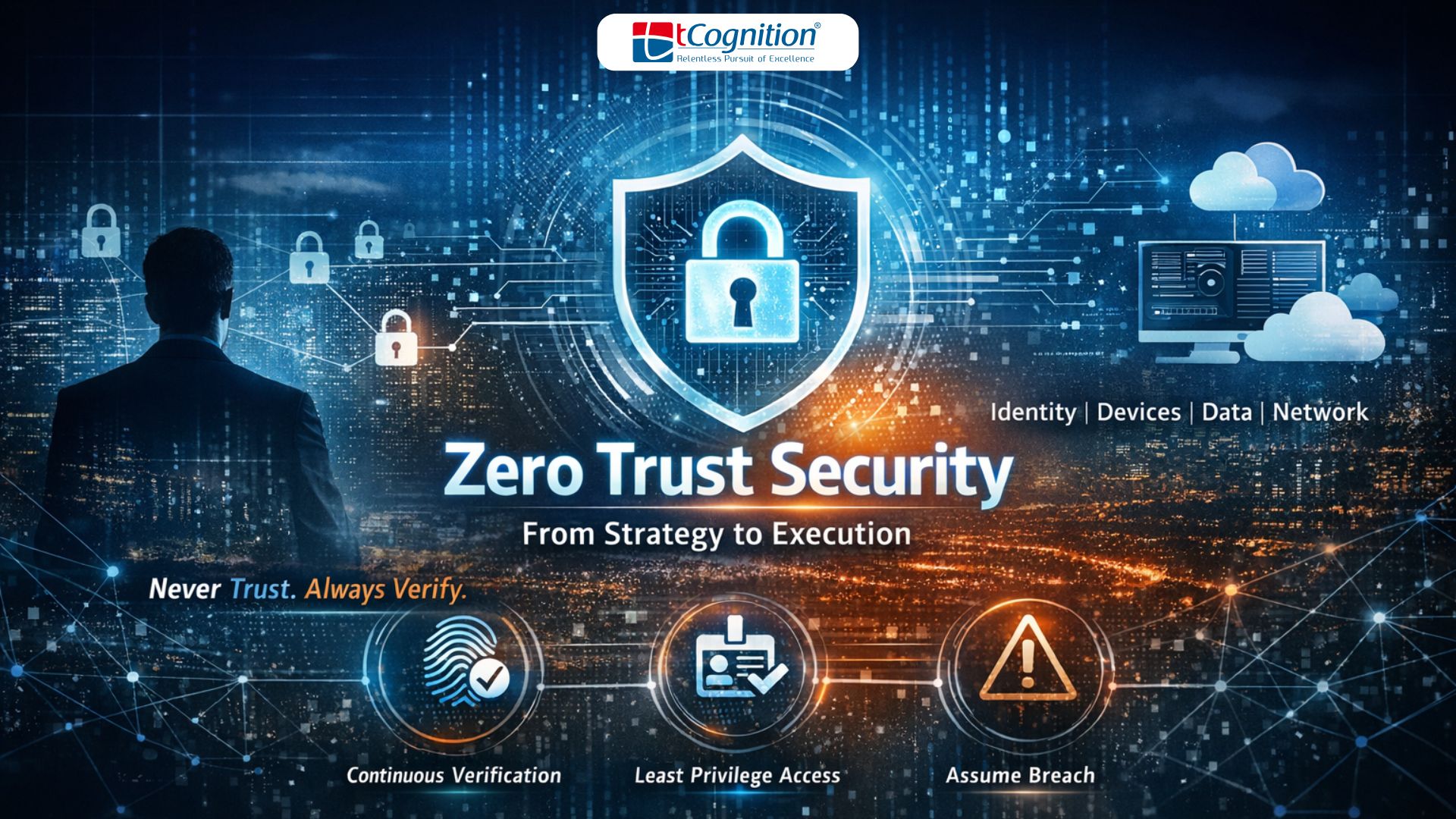
Zero Trust is not a single product. It is a strategic cybersecurity framework built on three core principles:
- Continuous verification of users, devices, and workloads
- Least privilege access to minimize risk exposure
- Assume breach mindset to limit lateral movement
Rather than protecting a broad network perimeter, Zero Trust focuses on securing identities, applications, and data directly.
This approach is especially critical in hybrid and multi-cloud environments where workloads and users operate outside traditional boundaries.
Key Components of a Zero Trust Security Model
A successful Zero Trust implementation integrates multiple layers of protection.
1. Identity and Access Management (IAM)
Identity becomes the new security perimeter. Strong authentication and contextual access policies ensure only verified users gain access to resources.
This includes:
- Phishing-resistant multi-factor authentication
- Passwordless authentication mechanisms
- Privileged access management
- Continuous identity validation
2. Micro-Segmentation
Micro-segmentation prevents attackers from moving laterally across networks. Instead of broad internal access, policies are enforced at the application and workload level.
3. Device and Endpoint Security
Access decisions consider device health, compliance status, and security posture before granting permissions.
4. Data-Centric Security
Sensitive data must be protected independently of infrastructure through encryption, data classification, and monitoring.
5. Continuous Monitoring and Threat Detection
Advanced analytics and AI-powered monitoring systems identify anomalies and respond in real time, reducing breach impact.
How to Implement Zero Trust: A Practical Roadmap
Transitioning to Zero Trust requires a phased approach aligned with business goals.
Step One: Assess Current Security Posture
Organizations must identify critical assets, map trust relationships, and evaluate identity governance gaps.
Step Two: Define the Protect Surface
Focus on securing sensitive data, critical applications, and privileged accounts first.
Step Three: Strengthen Identity Controls
Deploy strong authentication, eliminate legacy protocols, and implement role-based access policies.
Step Four: Segment Networks and Workloads
Redesign flat architectures to limit lateral movement risks.
Step Five: Enable Continuous Monitoring
Integrate SIEM, SOAR, and behavioral analytics to automate detection and response.
Zero Trust should be viewed as an ongoing program rather than a one-time deployment.
Business Benefits of Zero Trust Security
Organizations that successfully implement Zero Trust experience measurable improvements, including:
- Reduced breach impact and ransomware risk
- Stronger regulatory compliance (GDPR, HIPAA, ISO 27001)
- Improved visibility across cloud environments
- Enhanced protection against insider threats
- Increased customer and stakeholder trust
Zero Trust not only strengthens cybersecurity posture but also enables secure digital transformation initiatives.
Common Zero Trust Implementation Challenges
Despite its advantages, many organizations struggle with execution. Common barriers include legacy systems, fragmented cloud environments, unclear governance policies, and lack of executive alignment.
Zero Trust requires both technological modernization and organizational commitment.
How tCognition Helps You Achieve Zero Trust Security
Implementing Zero Trust Architecture demands deep expertise in cloud security, identity management, network segmentation, and AI-driven monitoring.
tCognition provides end-to-end Zero Trust consulting and implementation services designed to help enterprises move from strategy to execution.
Our Approach
Zero Trust Readiness Assessment
We evaluate your current infrastructure, identify security gaps, and develop a customized roadmap aligned with your business objectives.
Identity and Access Modernization
We deploy advanced authentication frameworks, enforce least-privilege policies, and implement privileged access management to secure your identity layer.
Hybrid and Multi-Cloud Security Integration
Whether operating across on-premises systems or cloud platforms, we standardize policies and strengthen visibility across environments.
Micro-Segmentation Strategy and Deployment
We redesign network architectures to limit lateral movement while maintaining operational efficiency.
AI-Powered Threat Detection and Response
By integrating advanced monitoring and automation solutions, we reduce detection time and improve incident response effectiveness.
Data Protection and Compliance Alignment
We secure sensitive data assets and ensure regulatory alignment with global security standards.
Why Choose tCognition for Zero Trust Implementation?
- Proven expertise in AI-driven security solutions
- Deep experience in hybrid and multi-cloud environments
- Business-aligned cybersecurity strategies
- Scalable and future-ready architecture design
- Continuous governance and optimization support
We help organizations build a resilient, identity-first security ecosystem that supports innovation without compromising protection.
The Future of Zero Trust Security
As enterprises increasingly adopt AI, edge computing, and advanced automation, Zero Trust will continue to evolve. Identity validation will extend beyond human users to machine identities and autonomous systems. AI-native applications will require dynamic, policy-driven access enforcement.
Organizations that implement Zero Trust today will be better positioned to adapt to tomorrow’s cybersecurity challenges.
Final Thoughts
Zero Trust Security is no longer optional—it is a strategic necessity for modern enterprises operating in cloud-first environments.
By aligning with established frameworks from the National Institute of Standards and Technology and partnering with experienced cybersecurity experts like tCognition, businesses can transform security from a reactive defense mechanism into a proactive, resilient foundation for growth.
If your organization is ready to strengthen its cybersecurity posture, modernize identity governance, and implement a comprehensive Zero Trust Architecture, tCognition is ready to help you lead that transformation.